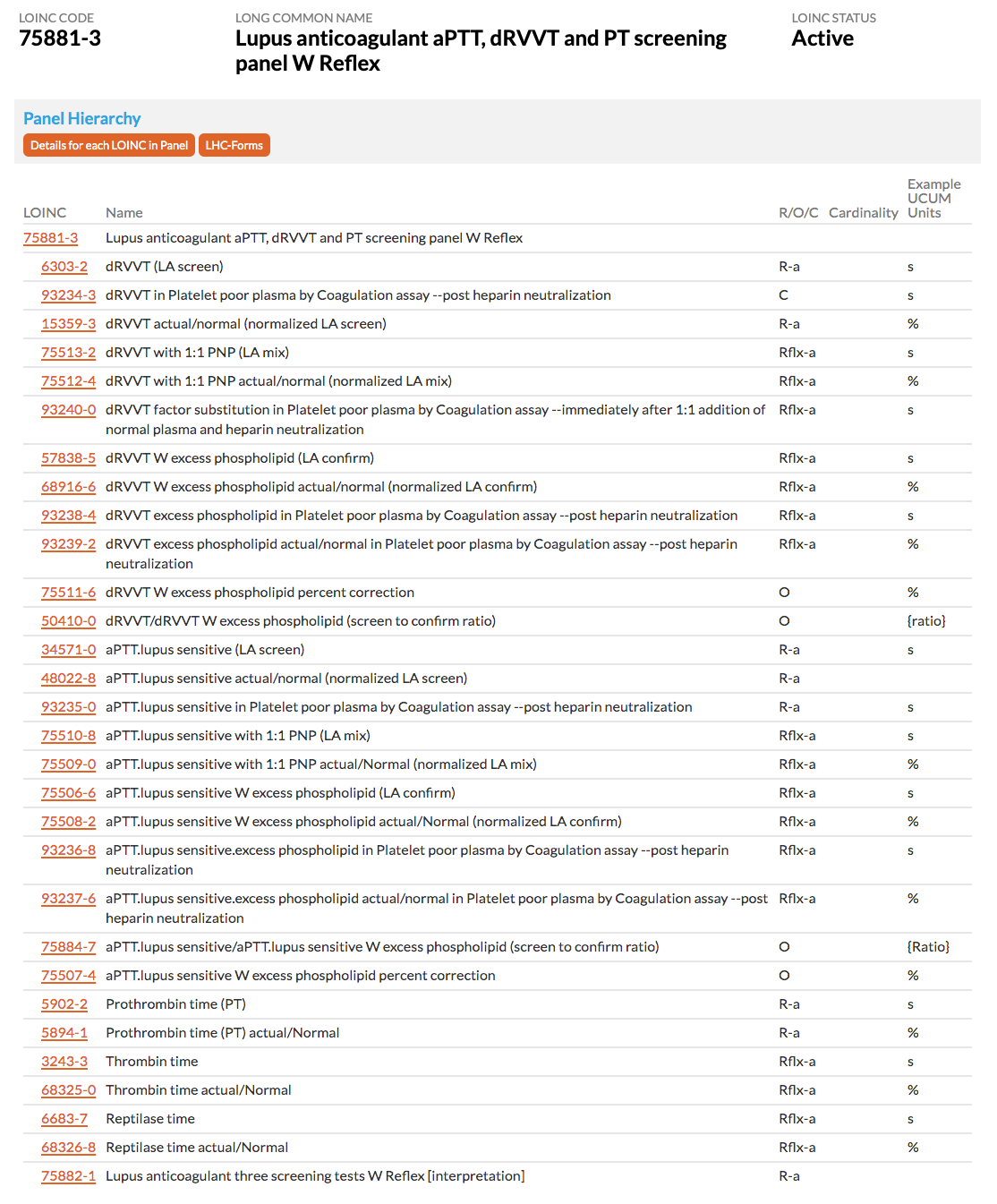
Within the LOINC panel structure, we can set an attribute for each element of the panel that denotes whether or not it should be present (conditionality) in the panel when resulted. The primary measures are always required, but the other elements of the panel may have different kinds of conditionality.
The conditionality attribute is visible on the details pages for panel terms under the column “R/O/C” and stored in the ObservationRequiredInPanel field of the LOINC Panels and Forms File (available within the primary LOINC download).
Through version 2.48 of the LOINC database, the conditionality choices were limited to R (Required), O (Optional) and C (Conditional). Example of simple order set with terms that are either R or O:
| 24358-4 | Hemogram WO platelets panel | – | Pt | Bld | Qn | R/O/C |
|---|---|---|---|---|---|---|
| 26464-8 | Leukocytes | NCnc | Pt | Bld | Qn | R |
| 26453-1 | Erythrocytes | NCnc | Pt | Bld | Qn | R |
| 718-7 | Hemoglobin | MCnc | Pt | Bld | Qn | R |
| 20570-8 | Hematocrit | VFr | Pt | Bld | Qn | R |
| 30428-7 | Mean corpuscular volume | EntVol | Pt | RBC | Qn | R |
| 28539-5 | Erythrocyte mean corpuscular hemoglobin | EntMass | Pt | RBC | Qn | R |
| 28540-3 | Erythrocyte mean hemoglobin concentration | MCnc | Pt | RBC | Qn | R |
| 30384-2 | Erythrocyte distribution width | EntVol | Pt | RBC | Qn | O |
| 30385-9 | Erythrocyte distribution width | Ratio | Pt | RBC | Qn | O |
| 76069-4 | Erythrocytes.hypochromic/100 erythrocytes | NFr | Pt | Bld | Qn | O |
| 76090-0 | Erythrocytes.hyperchromic/100 erythrocytes | NFr | Pt | Bld | Qn | O |
Starting with version 2.50 (December 2014), we expanded the choices beyond R, O and C to include R-a (Required with alternative), Rflx (Reflex) and Rflx-a (Reflex with alternative). The expanded choices better accommodate reflex tests, cases in which more than one test could be used to fulfill a given requirement of the panel, and focus the use of C (which had previously been used as a “catch-all” for many types).
The following table describes the expanded set of conditionality choices.
Table 29: Options for Term Conditionality within Panels
| Code | Meaning | Discussion /Definition |
|---|---|---|
| R | Required | Means this test must be included. |
| R-a | Required with alternatives | Means required but has alternatives. The alternatives will usually be paired, and both will be marked with the R-a code. Results for at least one member of the pair must be included in the panel to satisfy the required condition, but both may be included. The C, conditional, had been used to deal with these cases in the past. The rule for pairing up of the alternatives for a given purpose will be described in a narrative usually in the panel description because the same rule will apply to many pairings in the panel. For example, the LA panel includes lots of coagulation measures and almost all can be reported as an actual time and/or as the ratio of patient time to the normal time. Measures of the same clotting function that differ only by how they are reported would be considered paired alternatives in this panel. More specific pairing rules may also be asserted in the “condition for inclusion” field associated with each item in the panel. |
| C | Conditional | Means that the required status of a given variable depends on other factors. This was too much of a waste basket category, which is why we added some new categories to specify what had usually been lumped as conditional. |
| O | Optional | Means the variable may be included or not, but whether it is included or not has no bearing on the whether a given set of result represents the given panel. Simple calculations derived from other reported measurements and ask at order entry questions are almost always optional. |
| Rflx | Reflex | Means this test will be included in the panel only if it satisfies a reflex condition based on other results in the panel. Such cases had also been lumped under the conditional code in the past. In general, we will not define specific rules for reflexing except in very general terms. |
| Rflx-a | Reflex with alternatives | Means that that the test is a reflex but that another test in the panel can serve as an alternate and either or both of these reflex tests can be reported. But if the reflex condition is met, at least one of the alternative pairs must be included. As in the case of R-a, what tests pair up as alternatives will be defined in a narrative in the panel description of the condition for inclusion field. |
If more than one measure can serve as a primary measurement, then both of them will be required with alternatives (R-a), and the criteria is that at least one of them must be present. An example would be the absolute count of neutrophils versus the percentage of total white count of neutrophils in a differential blood count – if one is absent the other must be present (of course they are both often reported). Example of an order set that includes terms with R-a conditionality:
| 24326-1 | Electrolytes 1998 panel | – | Pt | Ser/Plas | Qn | R/O/C |
|---|---|---|---|---|---|---|
| 2951-2 | Sodium | SCnc | Pt | Ser/Plas | Qn | R |
| 2823-3 | Potassium | SCnc | Pt | Ser/Plas | Qn | R |
| 2075-0 | Chloride | SCnc | Pt | Ser/Plas | Qn | R |
| 1963-8 | Bicarbonate | SCnc | Pt | Ser/Plas | Qn | R-a |
| 2028-9 | Carbon dioxide | SCnc | Pt | Ser/Plas | Qn | R-a |
| 33037-3 | Anion gap | SCnc | Pt | Ser/Plas | Qn | O |
The criteria or explanation for when the tests with R-a, Rflx and Rflx-a should be included in the results for a particular panel can be seen on the comprehensive details page available within RELMA and the online LOINC search application (SearchLOINC).
Note that the conditionality assigned to a term is panel-specific. In other words, a given test may be required in one context and optional in another, which is why both the conditionality and criterion for inclusion only appear in the panel details and not in the individual term details.
We should acknowledge that LOINC includes many panels without the required status having been marked and that the conditional status has not been employed everywhere that it could have been, and that many terms marked as conditional under the previous model probably would be better categorized as required with alternatives, reflex, or reflex with alternative. (We still have LOINC development work to do.)
7.4.1 Lupus anticoagulant testing as an example of complex conditionality
Here we describe lupus anticoagulant testing as a prototype to illustrate the use of conditionality. At the core of lupus anticoagulant testing is a three step process using a given coagulation measure, such as dRVVT. The first is a screening to determine whether a clotting abnormality exists. The second is a mixing study, in which the patient specimen is mixed with pooled normal plasma (PNP) and the same test (e.g. dRVVT) is rerun. This second test is used to evaluate whether the clotting problem is due to a clotting factor deficiency, such as occurs in Hemophilia. The third is yet another repeat of the same test (e.g. dRVVT) mixed with excess phospholipid – also called the confirmatory test. Lupus anticoagulant is declared present if the addition of excess phospholipid normalizes the result.
There are a number of variations in lupus anticoagulant testing algorithms across laboratories. Some labs do the confirm test second and the mixing study third (if needed). The International Society of Thrombosis and Haemostasis (ISTH) recommends using two clotting tests: dRVVT and aPTT-LA (lupus sensitive), each reflexing to confirm and/or mixing study. However, at least two labs use three screening tests, adding PT to the dRVVT and aPTT-LA, reflex to mixing and confirm studies from these, and add further reflex testing, including thrombin time and from that a reflex to reptilase time. There are also variations in how the results are reported, e.g. as actual clotting times and/or as ratios of the actual time to the time of normal. And some labs define the kind of phospholipid they use for the confirm study, i.e., hexagonal or platelet derived phospholipid.
The lupus anticoagulant panel for three screening tests shown below illustrates a number of issues related to conditionality described above. The three screening tests (dRVVT, aPTT and PT) are all required but can either be reported as the actual result or actual/normal, therefore all six terms are assigned the conditionality R-a. The mixing and confirmatory tests as well as thrombin time and reptilase time are only run if any of the screening tests are out of range and when run, can also be report as actual or actual/normal; therefore, all of these terms are assigned Rflx-a. The dRVVT and aPTT percent correction and screen to confirm ratio may not be reported by all laboratories and therefore have an O status. Finally, the overall interpretation must be reported and so is assigned R.